
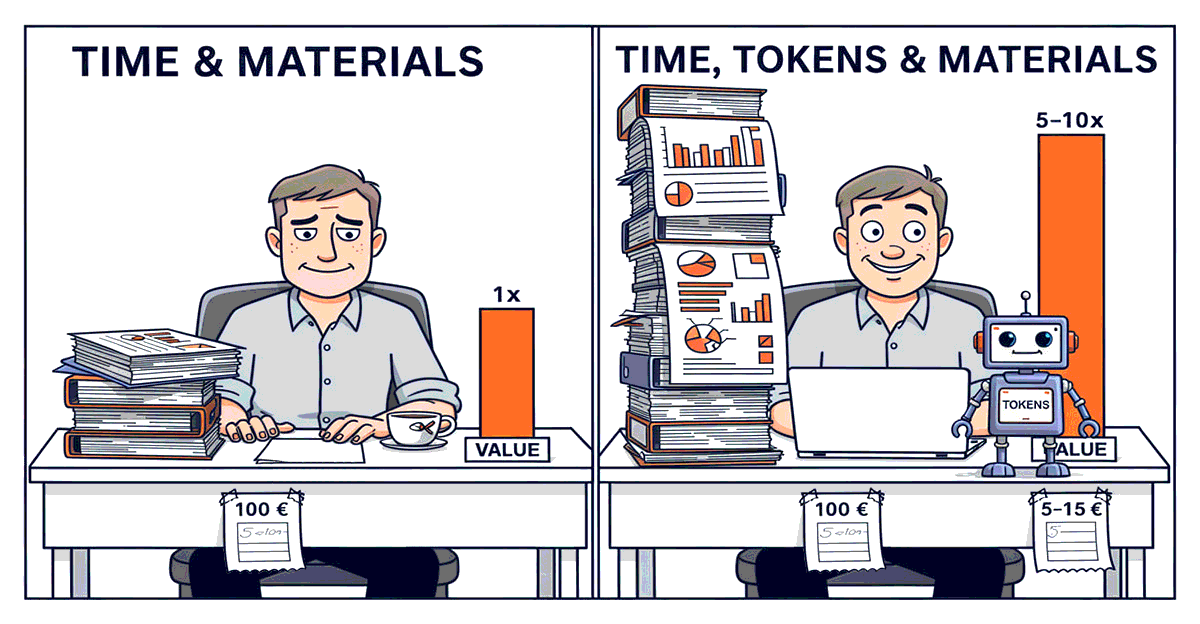
My time sheet has a new line on it. T&M is now TT&M: Time, Tokens & Materials.
For every 100 € of billed thinking, 5 to 15 € of tokens.
These are not numbers I picked because they made a nice picture. Since the first of January this year I have spent 22,900 € on tokens, on customer projects and on my own internal developments. It is measured, paid, and in the books next to every other line.
And no, none of it went into cat videos or AI slop. It went into thermodynamic models, process simulation, molecular property prediction, and code that runs in a factory on a Tuesday night when nobody is watching it.
What leaves my desk in a week is now five to ten times what it used to be.
The easy version of this story is that I got faster with a very patient assistant. That is true, and it is the boring part.
What I did not expect is that I became a better engineer, because I can now afford depth. When I trained the Cheméo Relay models, six properties came back with a test R² near zero, and the comfortable reading was that the experimental data was too thin to learn from. Instead I ran a gradient-boosted tree on a dozen plain descriptors, on the same split, and it beat my graph network on all six. The data was learnable, the fault was in my readout, which averaged over the atoms and threw molecular size away. That cross-check is exactly the kind of work I could never have justified on a customer invoice.
The constraint was never curiosity, it was the budget for following it, and that budget moved.
The cheap part got automated, the expensive part got deeper
Part of what I billed before was the transcription of thinking: the boilerplate, the third rewrite of a report section, the afternoon spent remembering how a solver wants its inputs. Clients paid for those hours because there was no way to separate them from the rest. That part is gone and nobody should mourn it. Letting the machine do it is one of the few decisions in this business with no downside.
But the hours that were freed did not disappear from the invoice, they moved. They went into the second convergence check, the sensitivity study that used to be a paragraph of hand-waving, the alternative model I would have dismissed on grounds of budget rather than physics.
So the day costs the same and buys something different: less typing, more checking. That is a better trade than it sounds, because in this work the errors that hurt are never in the typing.
Disruption is the polite word
Everyone in software services says disruption, because the word suggests you adapt and carry on. I think it is the destruction of the business model.
The simple presentation layer, the internal dashboard, the proof-of-concept data analysis, the CRUD app with a login screen: that work is now close to free. Not cheaper, close to free. If that is what a company sells by the day, the day rate has no floor left to stand on.
What survives is the domain knowledge on top: seeing that the flash calculation converged to a physically meaningless root, or that the model fits beautifully because the training set is contaminated, or seeing which regulation applies to the plant today and which one applied fifteen years ago and still governs the equipment installed then.
You are safe as long as you carry something the model does not: judgement about one specific domain, earned slowly and expensively. For now.
How fast does model quality climb?
That 100 € of billed thinking is a PhD and 25 years of experience. I do not know how fast the models climb toward it, and nobody does. The direction is not in doubt, only the slope.
And the consequence is uncomfortable. The faster that climb, the faster the engineering and contracting companies shrink. Not because the customer finds a cheaper supplier, but because the customer stops needing a supplier at all. The work moves in-house, done by two good engineers with access to the best models available.
How do you grow an expert now?
I became useful by doing work that was mostly beneath me: bad Fortran, data cleaning nobody wanted, report sections that came back covered in red. I learned what a wrong answer looks like by producing several thousand of them and having someone senior point at them.
That is exactly the layer the models now do, fast, cheap, and usually right.
So the junior engineer arrives, is handed a tool that produces plausible output on the first attempt, and never spends the three years of being wrong that build the instinct. Then in fifteen years, who reviews the answer? Who looks at a converged solution and says that number cannot be right, before being able to explain why?
I do not have an answer. I have a suspicion that the firms which survive will be the ones that deliberately pay for juniors to do work that no longer strictly needs doing, purely to grow the person. That is an expensive form of long-termism, and I have rarely seen it survive contact with a quarterly budget.
So the line stays on the sheet
Small, itemised, 5 to 15 € against 100 €. The token cost is the least interesting number on the invoice, what it implies about the other one is the part that keeps me up.